Search Results
742 results found with an empty search
- NEW HOUSE FOR BLISS
By the mercy of our dear spiritual master Srila Prabhupada and by the mercy of Lord Caitanya Mahaprabhu we were able to find a very nice house to continue hosting our Krishna conscious programs such as kirtans, readings and feasts. We shifted from East to South London and we would like to invite you to visit us soon. Of course, the new house should never be taken as granted and we shall do our best to increase our service and commitment to the mission of Srila Prabhupada even more. The daily online livestreams on Facebook inspire hundreds of devotees to hear and discuss Srila Prabhupada's books and Prabhus invite friends to taste the bliss of the Sunday feasts. Although the location is changed, our determination to give Krishna consciousness to everyone has not. Please check out our new upcoming celebration of Lord Caitanya's appearance day and book yourself for one of our Sunday feast. As before, we hold an outdoor sankirtana every Saturday and you are invited to participate as well. Let's flood this world with Srila Prabhupada's mercy more and more. We shall conclude with a nice letter written by Srila Prabhupada on a similar occassion of acquiring a new house by devotees: Please accept my blessings. Your letter dated December 21 along with the picture of the new house was duly received by me while I was in Boston and we enjoyed the few days of meeting together in that Temple. It was a great transcendental pleasure to meet you all. Your statement in the letter, "All glories to Sankirtana, Prasadam and Srimad-Bhagavatam'' is very welcome. Before coming to your country, when I was in India and I was planning to come here, I was thinking in the same way. I was thinking that my preaching work in this country would be a difficult job for me on account of the country's position being completely different from the principles of Bhakti cult. At that time I was also thinking of chanting and dancing in Sankirtana as well as distributing prasadam in the matter of my preaching Bhagavatam. So this planning has by the grace of my Guru Maharaja and Krishna become successful in the practical field. Forty years before when two of my eldest God-brothers came to London with this mission they simply devoted their time in lecturing in some renowned public place and inviting some leading politician to preside over the meeting. You know very well that when I began my preaching work in New York I never followed this policy of lecturing amongst the stereotyped politicians or elites of the society. And if I would have followed such a policy, I think I would also have gone back to India without any success. I think this policy of Sankirtana, Prasadam and Srimad-Bhagavatam has been successful in all the centers. Please therefore follow this transcendental policy with heart and soul and make your center as spiritually opulent as far as possible. Your ever well-wisher, A.C. Bhaktivedanta Swami Letter to: Brahmananda -- Los Angeles 6 January, 1970
- Conversation between Lord Caitanya and Chand Kazi.
Today we celebrate the divine appearance of Lord Sri Caitanya Mahaprabhu, the inaugurator of the sankirtana movement, who is the self-same Lord Krsna, the Supreme Personality of Godhead. This is a chapter from the book "Teachings of Lord Buddha (from the Vedic point of view)" compiled from the teachings of His Divine Grace A.C.Bhaktivedanta Swami Prabhupada that captures one of the wonderful pastimes of Lord Caitanya. The Lord says that He incarnates Himself in every millennium. This indicates that He incarnates also in the present Age of Kali. As stated in the Srimad-Bhagavatam, the incarnation in the Age of Kali is Lord Caitanya Mahaprabhu, who introduced the worship of Krsna by the sankirtana movement, the congregational chanting of the holy names, and spread Krsna consciousness throughout India. He predicted that this culture of sankirtana would be broadcast all over the world, from town to town and village to village. Lord Caitanya, as the incarnation of Krsna, the Personality of Godhead, is described indirectly in the confidential parts of the revealed scriptures; such as the Upanisads, Mahabharata and Bhagavatam. The devotees of Lord Krsna are very much attracted by the sankirtana movement of Lord Caitanya. This avatara of the Lord does not kill the miscreants, but delivers them by His causeless mercy. There is a story about how Lord Caitanya, who was then known by the name Nimai Pandita, started the civil disobedience movement. At that time Bengal, the province of India, was being governed by the Pathans, or Muhammadans, and so there ruled a Muhammadan magistrate called Kazi Saheb. The brahmanas of Navadvipa lodged a complaint to Kazi Saheb: “This boy, Nimai Pandita, has started a movement called Hare Krsna. People are getting excited to chant this Hare Krsna mantra, and He is propagating that one will get all perfection simply by chanting Hare Krsna.” The brahmanas thought, “If this boy makes propaganda and popularizes this Hare Krsna movement, then what about us?” They were from the priestly class, so naturally they were concerned about their livelihood. They thought, “If people take to this chanting exclusively, then what about our churches, mosques and temples? No one will come.” So they lodged a complaint to Chand Kazi: “Nimai Pandita is doing something that is against our Vedic rituals. It is not a Hindu religion.” Of course, Chand Kazi was a Muhammadan magistrate, but after all, he was meant to give justice to the people, so when the chief brahmanas complained, he took action and sent some constables to warn the followers of Lord Caitanya. The constables said, ‘You are causing a disturbance. There is a complaint. You cannot do this Hare Krsna chanting.” So the followers informed Caitanya Mahaprabhu, “Chand Kazi has warned us not to chant Hare Krsna. What shall we do?” Caitanya Mahaprabhu said, “Never mind, just go on chanting.” When the magistrate saw that they had not stopped, he sent some constables and the government police force; who broke their mrdangas and dispersed the crowd. When this information was given to Caitanya Mahaprabhu He said, “All right, then we shall start civil disobedience.” He called for many thousands of people. He was very popular. Although He was only a sixteen-year-old boy at that time, He was so learned that He even defeated a great scholar of the name Kesava Kasmiri. At the same time, this incidence shows that Caitanya Mahaprabhu was so popular that simply by His calling, many hundreds of thousands of people with mrdangas gathered. They began kirtana (chanting) in the street and went to the house of Kazi. At that time Kazi understood, “This is a mass movement. My order will not be effective. There will be some disturbance.” So he came to his senses and he wanted to make some compromise with Caitanya Mahaprabhu. First of all there was some discussion. Chand Kazi, just as Caitanya Mahaprabhu, was a very learned scholar, therefore he first wanted to find a compromise. He said, “Nimai, You are just like a boy to me, and according to our village relationship, You are my nephew because I used to call your maternal grand-father Nilambara Cakravarti ‘caca’ (uncle). So in that sense, Your mother is my sister. And because Your mother is my sister, You are my nephew. So why are You so angry upon Your uncle?” In India, even in the interior villages, all the Hindu and Muslim communities used to live very peacefully by establishing relationships amongst each other. The young men called the elderly members of the village by the name caca, or kaka, which means “uncle,” and men of the same age called each other dada, “brother.” The relationship was very friendly. There were even invitations from Muslim houses to Hindu houses and vice versa. Both the Hindus and the Muslims accepted the invitations to go to one another's houses to attend ceremonial functions. Even up until fifty or sixty years ago, the relationship between Hindus and Muslims was very friendly, and there were no disturbances. We do not find any Hindu-Muslim riots in the history of India, even during the days of the Muslims' rule over the country. The conflict between Hindus and Muslims was created by polluted politicians, especially foreign rulers, and thus the situation gradually became so degraded that India was divided into Hindustan and Pakistan. Previously, however, the relationships were nice. So to this Caitanya Mahaprabhu replied, “Yes, I have come to My uncle's house to be received very nicely, but my uncle went upstairs and I do not know why. So I am very glad that he has come down.” In this way, things were settled. Then they started talking. First of all Caitanya Mahaprabhu asked Chand Kazi, “My dear mama (maternal uncle), what kind of religion is it that you eat your father and mother?” That was His first challenge. Kazi responded, “What are you saying? We eat our father and mother?” Lord Caitanya replied, “Yes, because you eat the cow. The cow gives you milk, so she is your mother. You are drinking milk and then killing your mother. The bull helps you in agricultural affairs by producing grains, so he is like the father, who gives you grains to eat. Therefore, you are killing your father and mother. Why is that?” Chand Kazi, as a very learned scholar, argued that cow-killing is similarly recommended in the Vedas. This conversation is also recorded in the pages of the Caitanya-caritamrta: tomara vedete ache go-vadhera vani ataeva go-vadha kare bada bada muni “As a learned scholar, the Kazi challenged Caitanya Mahaprabhu, ‘In Your Vedic scriptures there is an injunction for killing a cow. On the strength of this injunction, great sages performed sacrifices involving cow-killing.’” (Cc. Adi 17.158) The Vedas are transcendental literature that can be learned by the process of aural reception from the right source. The Vedas are, therefore, called “srutis”, i.e., the science that is learned by the process of hearing. In this Vedic literature, sacrifices of animals are sometimes recommended under religious rites. prabhu kahe,—vede kahe go-vadha nisedha ataeva hindu-matra na kare go-vadha “Refuting the Kazi's statement, the Lord immediately replied, ‘The Vedas clearly enjoin that cows should not be killed. Therefore, every Hindu, whoever he may be, avoids indulging in cow-killing.’” (Cc. Adi 17.159) It is said there that if one wants to eat meat, he should kill a goat before the goddess Kali and then eat it. Meat-eaters are not allowed to purchase meat or flesh from a market or slaughterhouse. There are no sanctions for maintaining regular slaughterhouses to satisfy the tongues of meat-eaters. As far as cow-killing is concerned, it is completely forbidden. Since the cow is considered a mother, how could the Vedas allow cow-killing? Sri Caitanya Mahaprabhu pointed out that the Kazi's statement was faulty. In the Bhagavad-gita (18.44) there is a clear injunction that cows should be protected: krsi-goraksya-vanijyam vaisya-karma svabhava-jam. “The duty of vaisyas is to produce agricultural products, trade and give protection to cows.” Therefore, it is a false statement that the Vedic scriptures contain injunctions permitting cow-killing. Sri Caitanya Mahaprabhu continued, jiyaite pare yadi, tabe mare prani veda-purane ache hena ajna-vani ataeva jarad-gava mare muni-gana veda-mantre siddha kare tahara jivana “In the Vedas and Puranas there are injunctions declaring that if one can revive a living being, he can kill it for experimental purposes. Therefore, the great sages sometimes killed old cows, and by chanting Vedic hymns they again brought them to life for perfection.” (Cc. Adi 17.160-161) This sacrifice was performed in order to exhibit the efficacy of powerful Vedic mantras which, if properly chanted, could perform wonders. For such a sacrificial purpose an old bull was therefore selected, and after sacrificing it on the altar of “yajna” the animal was again resurrected to live a new span of life. Therefore, unless one is able to revive the animal’s life, no such animal sacrifice should be attempted. Sri Caitanya Mahaprabhu continued, jarad-gava hana yuva haya ara-vara tate tara vadha nahe, haya upakara kali-kale taiche sakti nahika brahmane ataeva go-vadha keha na kare ekhane “The killing and rejuvenation of such old and invalid cows was not truly killing but an act of great benefit. Formerly there were powerful brahmanas who could make such experiments using Vedic hymns, but now, because of the Kali-yuga, brahmanas are not so powerful. Therefore, the killing of cows and bulls for rejuvenation is forbidden.” (Cc. Adi 17.162-163) In this age, because such powerful brahmanas who can chant the mantras rightly and rejuvenate the animal back to life are lacking, it is not possible. Therefore, in the sastras these sort of sacrifices are forbidden. Sri Caitanya Mahaprabhu thus quoted a verse from authoritative scriptures, asvamedham gavalambham sannyasam pala-paitrkam devarena sutotpattim kalau panca vivarjayet “In this Age of Kali, five acts are forbidden: the offering of a horse in sacrifice, the offering of a cow in sacrifice, the acceptance of the order of sannyasa, the offering of oblations of flesh to the forefathers, and a man's begetting children in his brother's wife.” (Brahma-vaivarta Purana, Krsna-janma-khanda 185.180) Another explanation about meat-eating after sacrifice is given in the Bhagavata Purana. It is said there that sexual intercourse with a woman, meat-eating or indulgence in intoxication recommended in the Vedas is not for encouraging such animalistic habits. Due to natural instincts, such desires are already present in an animal, so there is no need to recommend it under the pretext of religious rites. The idea is different. Namely, these concessions are recommended in the sastras to restrict the animalistic habits. They allow meat-eating and intoxication only after sacrificial rites and sexual intercourse only within legal marriage in order to introduce the regulation of such extravagant sense-gratifying instincts. The regulative principles are so designed that in due course these animal-propensities may be subdued completely with the revival of one’s divine nature. For example, when the government opens a liquor shop, it does not mean the government is encouraging people to drink liquor. If the government does not allow drunkards to drink, they will create havoc and start to distill liquor illicitly. So just in order to prevent this situation, the government opens a liquor shop with very high prices. If the cost of the alcohol is one dollar, the government will charge sixty. The whole point is not to encourage drinking, but to restrict it. At least this was the original idea in India. Similarly, when there is allowance of sex life, meat-eating or drinking in the sastras, they are not meant to instigate people to go on with this business as much as they can, but they are meant for restriction. Prior to the advent of Lord Buddha, the portions of the Vedic literature dealing with animal sacrifice were grossly misused, and instead of subduing the animalistic propensities, men used to indulge in them with unrestricted extravagance. Just like nowadays, there is one particular so-called spiritual mission where the members claim to be devotees of goddess Kali. Their real mission is, however, to eat meat. That is why they have become devotees of goddess Kali. As Caitanya Mahaprabhu explained, these sacrifices were not meant to kill the animals, but to test the strength of the Vedic mantras. Thus when people began to eat meat unrestrictedly on the plea of Vedic sacrifice, Lord Buddha, who is the incarnation of Krsna, appeared to stop this animal killing. That is the meaning of the prayer about Lord Buddha written by the poet Jayadeva, nindasi yajna-vidher ahaha sruti-jatam sadaya-hrdaya darsita-pasu-ghatam kesava dhrta-buddha-sarira jaya jagadisa hare “My dear Lord, You have now appeared as Lord Buddha, and You are decrying the Vedic rituals because You have so much compassion for the poor animals who are being killed unnecessarily. All glories to Jagadisa, who has now assumed the form of Lord Buddha in order to enact His pastimes.” Another explanation of Lord Buddha’s appearance is as follows. It is said that because Krsna was constantly performing various types of sacrifices, and was inviting the demigods from the higher planetary systems, the demigods were almost always absent from their consorts. Therefore, the wives of the demigods, regretting the absence of their husbands, began to pray for the appearance of Lord Buddha, the ninth incarnation of Krsna in the Age of Kali. In other words, instead of being pleased that Lord Krsna had come, they began to pray for Lord Buddha because Lord Buddha stopped the ritualistic ceremonies and sacrifices recommended in the Vedas, in order to discourage animal killing. The demigods' wives thought that if Lord Buddha appeared, all kinds of sacrifices would be stopped, thus their husbands would not be invited to such ceremonies and would not be separated from them. Sometimes people inquire, “Why don't the demigods from higher planetary systems come to this earth planet nowadays?” The plain answer is that since Lord Buddha appeared and began to deprecate the performance of sacrifice in order to stop animal killing on this planet, the process of offering sacrifices has been stopped, and the demigods do not care to come here anymore. PURCHASE THE TEACHINGS OF LORD BUDDHA (from the Vedic point of view) HERE
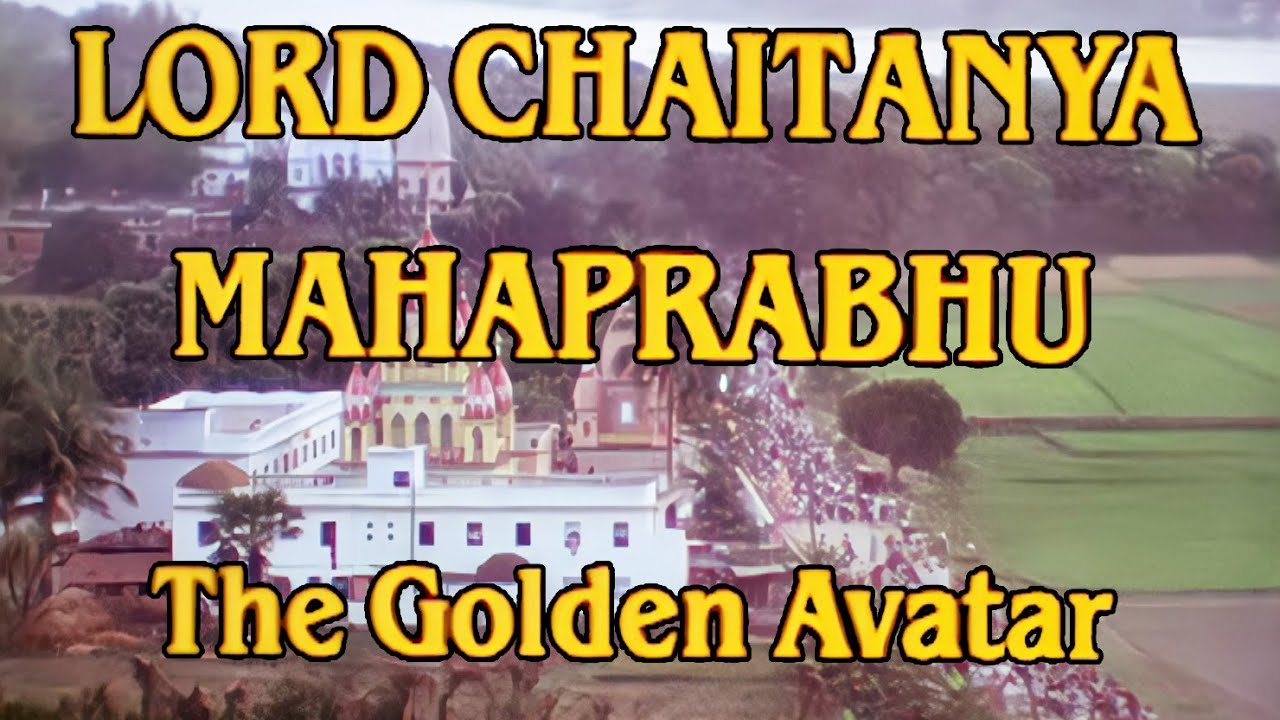
- The Golden Avatar - Lord Caitanya Mahaprabhu's Life and Teaching
Watch this incredible and beautiful documentary about Lord Caitanya Mahaprabhu, the Golden Avatar of Krsna. Lord Caitanya is Krsna Himself, and He has appeared in this world very recently, only 500 years ago! The teachings of Lord Caitanya and the teachings of Krsna in the Bhagavad Gita are one and the same, but Lord Caitanya Mahaprabhu gives us a practical example of how to surrender unto Krsna and worship Him in this age of Kali.
- Did We Fall From the SPiritual world?
Srila Prabhupada gives an elaborate answer to this question in the following conversation. Devotee (4): Srila Prabhupada, you say in your books so many times that somehow or other we have fallen into this material world due to our enviousness or our independence. Prabhupada: Many, there are many reasons. Devotee (4): I can't seem to get a grasp on this at all. If we in our original constitutional position as part and parcel of Krsna, and in that position, that original position of full knowledge and full bliss and being in our eternal nature... Now I have some experience of how strong this material energy is and how maya works somewhat, but if I had known this and had this full knowledge, then I would have had this knowledge of how maya works and how I might fall. Prabhupada: You read the life of Jaya, Vijaya, Hiranyakasipu, Hiranyaksa? They were Krsna's doorkeepers. How they fell down? Did you read it? Did you read the life of Hiranyakasipu or Hiranyaksa? Devotee (4): Yes, Prabhupada. Prabhupada: So how they did fall? They are from Vaikuntha. They are Krsna's personal associates, keeping the doorkeepers. How did they fell down? Anyway, there is chance of falling down at any moment. Devotee (4): Well, in his family they wanted to enjoy the material world. Prabhupada: Whatever it may be, the falldown is there. So because we are living entities, we are not as powerful as Krsna, therefore we may fall down from Vaikuntha at any moment. Iccha-dvesa samutthena sarge yanti parantapa. Find out this verse. Pusta Krsna: iccha-dvesa samutthena dvandva-mohena bharata sarva-bhutani sammoham sarge yanti parantapa [Bg. 7.27] "O scion of Bharata [Arjuna], O conqueror of the foe, all living entities are born into delusion, overcome by the dualities of desire and hate." Prabhupada: Purport. Pusta Krsna: "The real constitutional position of the living entity is that of subordination to the Supreme Lord, who is pure knowledge. When one is deluded into separation from this pure knowledge, he becomes controlled by illusory energy and cannot understand the Supreme Personality of Godhead. The illusory energy is manifested in the duality of desire and hate. Due to desire and hate the ignorant person wants to become one with the Supreme Lord and envies Krsna as the Supreme Personality of Godhead. Pure devotees, who are not so deluded or contaminated by desire and hate, can understand that Lord Sri Krsna appears by His internal potencies. But those who are deluded by duality and nescience think that the Supreme Personality of Godhead is created by material energies. This is their misfortune. Such deluded persons symptomatically dwell in dualities of dishonor and honor, misery and happiness, woman and man, good and bad, pleasure and pain, etc., thinking 'This is my wife, this is my house; I am the master of this house, I am the husband of this wife.' These are the dualities of delusion. Those who are so deluded by dualities are completely foolish and cannot understand the Supreme Personality of Godhead." Prabhupada: So even in the Vaikuntha, if I desire that "Why shall I serve Krsna? Why not become Krsna?" I immediately fall down. That is natural. A servant is serving the master, sometimes he may think that "If I could become the master." They are thinking like that, they are trying to become God. That is delusion. You cannot become God. That is not possible. But he's wrongly thinking. Vipina: Why doesn't Krsna protect us from that desire? Prabhupada: He's protecting. He says, "You rascal, don't desire, surrender unto Me." But you are rascal, you do not do this. Vipina: Why doesn't He save me from thinking like that? Prabhupada: That means you lose your independence. Vipina: And no love. Prabhupada: That is force. (indistinct) prema. In Bengali it is said "If you catch one girl or boy, 'You love me, you love me, you love me.' " Is it love? (laughter) "You love me, otherwise I will kill you." (laughter) Is that love? So Krsna does not want to become a lover like that, on the point of revolver, "You love me, otherwise I shall kill you." That is not love, that is threatening. Love is reciprocal, voluntary, good exchange of feeling, then there is love, not by force. That is rape. The... Why one is called lover, another is called rape? Vipina: But isn't it by force anyway? If we don't love Krsna, we suffer. Prabhupada: That is your business. You'll suffer. But that Krsna does not force you. He says the real, "You love me, you'll be happy. If you don't love, you suffer." But that is your business. Vipina: So what is the choice? Prabhupada: Choice is yours. If you are rascal, you don't make the choice, the best choice. You suffer. The rascals, they suffer. And intelligent men, they do not suffer. If you are intelligent, then Krsna says that "You surrender to Me," you surrender, then you are intelligent. If you are rascal, then you reject and you suffer. When a father says to his rascal son, "My dear son, you just hear me, do like this, you'll be happy." If he does not do it, he'll suffer. There is no other alternative. Guest (2): Srila Prabhupada, why is the material world made on the level of a jailhouse? It's made on the level of a jailhouse, that, I've been told, the attitude of a jail instead of the attitude. Prabhupada: Yes, because there will be so many criminals. Therefore government has to construct a jailhouse. It is government's not desire. It is expensive, unnecessary. But because there are rascals who will become criminal, the government has jailhouse. So one who wants to remain independent of Krsna, for them there is material world, "All right, you remain here." Vipina: We also say that Krsna is fulfilling the desires of every living entity. So if we want to enjoy independent of Krsna, why doesn't He let us really enjoy independent of Him? Prabhupada: That is not possible. That is maya it is called. You are not enjoyer, you are servant. Because you are willing to become enjoyer, you suffer, that's all. You are not enjoyer. Vipina: Then He's not fulfilling the desire. Prabhupada: No, you wanted to enjoy-enjoy at your risk. Sometimes you'll become the king of heaven, and sometimes you become the germs in the stool. Vipina: Hm, enjoy at your risk. (laughter) Prabhupada: Yes. No, that is the fact. Vipina: Instead of under His protection, you enjoy at your risk. Prabhupada: Therefore He advises, "Rascal, you give up all this enjoying spirit. You just surrender to Me, you'll be happy." But we don't accept it. Therefore sometimes we are in the heavenly kingdom, sometimes as a worm in the stool. That is going on. That is your risk. Evening Darsana -- July 8, 1976, Washington, D.C.
- Srila Prabhupada on Hegel
The following is an excerpt from a series of conversations with Srila Prabhupada on the topic of Western philosophy. These can be found in the book entitled Dialectic Spiritualism. Hayagriva: And, uh, we can go on to Hegel? Prabhupada: Yes. Hayagriva: He did quite a bit of reading in Indian philosophy, but it seems to be confined to impersonal... Prabhupada: Yes. Hayagriva: ...the Upanisads. Prabhupada: It is simply, Upanisads is just the opposite -- spirit is not matter. That is the instruction of Upanisads. Hayagriva: He writes, "Spirit, in so far as it is the spirit of God is not a spirit beyond the stars, beyond the world. On the contrary, God is present, omnipresent and exists as spirit in all spirits. God is a living God who is acting and working. Religion is a product of the divine spirit. It is not a discovery of man but a work of divine operation." Prabhupada: This is very important thing, that a man cannot manufacture religion. That is very important point. Therefore we say religion means the words, the order given by God. Just like Krsna says: sarva-dharman parityajya. [Bg 18.66] [Abandon all varieties of religion and just surrender unto Me. I shall deliver you from all sinful reaction. Do not fear.] "You have manufactured so many religious system. You give up, kick it out. It has no value. Here is religion." And in the beginning He said, dharma-samsthapanarthaya: "I have appeared to re-establish the principle of religion." [Bg 4.8] [In order to deliver the pious and to annihilate the miscreants, as well as to reestablish the principles of religion, I advent Myself millennium after millennium.] And He says at last that, "Give up. Kick out all this so-called religion. Here is religion." What is that? Mam ekam saranam: "You just surrender to Me." This is religion. And Bhagavata [6.3.19] says, dharmam tu saksad bhagavat-pranitam: "The order given by God, that is religion." Otherwise everything is bogus, it has no meaning. The same example: law means which is given by the government. You cannot say, "I have prepared the law." Who will care for you? Even the small law, "Keep to the right," that is religion. If you say, "What is the wrong? If I keep to the left..." No. That will not be accepted. "Keep to the right," is religion and, "Keep to the left" is criminal. So religious, pious and impious, everything on the order of Krsna, or God. If you follow strictly the instruction of Krsna, then you are religious, pious, transcendental, devotee, everything. And if you defy Krsna, you manufacture your own way, then you are rascal, asura: na mam duskrtino mudhah prapadyante naradhamah [Bg 7.15]. He is naradhamah. This is the way. Lowest of the mankind: naradhamah, who do not follow the instruction of Krsna; our God. [Those miscreants who are grossly foolish, lowest among mankind, whose knowledge is stolen by illusion, and who partake of the atheistic nature of demons, do not surrender unto Me.] Hayagriva: He writes, "The lifting of the spirit to God occurs in the innermost regions of spirit upon the basis of thought. Religion as the innermost affair of man has here its center and the root of its life. God is in his very essence thought and thinking, however His image and configuration, configuration be determined otherwise." Prabhupada: His image, if God is absolute, His image is also God. If God is absolute, then His words are also God. That is absolute conception. There is not different. So the image which we worship in the temple, if it is actually image of God, then it as good as God. God is absolute. God says that, "This earth, water..., so everything is My energy." So even if you say, "This image is made of stone," but the stone is God's energy, bhumi -- earth. So there is a regulative principle, just like a wire, a copper wire, it is carrying electricity. Although the copper wire is not electricity, but it is carrying electricity. Similarly, if you take even material -- otherwise spiritually everything is God, that is another thing. But materially if we distinguish that the copper wire, it appears as copper wire but if you touch, "Oh, there is electricity." So it is manipulated. Similarly, by the rules and regulation as enunciated by the experienced spiritual master and guru. Ah then even if you think it is stone, it is God. The same example, you see it is electric wire, but it is electricity. Similarly: arcye visnau sila-dhir gurusu nara-matih [Padma Purana]. It is..., this has been warned: don't think that this sila -- stone, is God. Just like Caitanya Mahaprabhu, as soon as saw Jagannatha, immediately fainted. So we have to be trained up by the instruction of God -- how to realize God everywhere. Hayagriva: Hegel considered, "History and theodicy to be integral." He looks on history, "As a justification of God," and he rejects the Vedic conception of history because he doesn't see it, "Unfolding any particular meaning." That is, "Universes are created, maintained and annihilated in an apparently meaningless way." For Hegel, "History has to tell the story of man's elevation to God. Apart from the history of man, God would be alone and lifeless. God seems to depend on human history. God is not transcendental but is manifest in the world." Prabhupada: But if He is dependent on history, how He is God? This is nonsense proposal. [laughing] He is dependent on history! Hayagriva: Doesn't the history of mankind necessarily... Prabhupada: Whatever it may be, God is independent -- svatantra. Janmady asya yatah anvayad itaratas ca arthesu abhijnah svarat [SB 1.1.1]. Svarat -- independent. He does not depend on anything; still He is God. That is God. If He is dependent on anything, then He is not God. Hayagriva: But does the history of man necessarily make any sense? He, he saw it as progressing, as man, here again is evolution... Prabhupada: As soon, as soon as there is creation there is history. From the very beginning, that this is the point of creation and it will go on, history, until it is ended. Just like as soon as you are born, your horoscope is made -- the history. Now throughout your whole life there are so many activities. And after, we also believe next, next life the history continues. But superficially we make history from the beginning to the end of this body, that's all. But God is not subject to such rule that, "God is created at a certain point and He is ended at a certain point." Then where is the question of history? There is no history. History is for the small things. For me there is past, present, future. For God there is no such thing as past, present, future. So where is the history? History means past, present, future. Hayagriva: Yes. Prabhupada: But God has no past, present, future. So where is history? It is all nonsense. He does not know what is the meaning of God. Hayagriva: Hegel placed a great deal of emphasis on human freedom. Prabhupada: There is no freedom. That is another nonsense. Hayagriva: Yes. [Laughter] Prabhupada: [laughs] He is subjected to birth, death, old age. Where is his freedom? That is another nonsense. Hayagriva: He accuses the Orientals, mainly the Indians... He says, "The Orientals do not know that the spirit is free in itself or that man is free in himself. Because they do not know it, they are not free." Prabhupada: But is he free? Why he died? [laughs] The Orientals he is accusing. Why he died? This is their nonsense speculation. Hayagriva: He says, "They only know that the one" -- that is, the one Brahman -- "Is free; therefore such freedom is only arbitrary." Prabhupada: Then why he says that the human being should be free? Hayagriva: He says, "This one, supreme one is therefore a despot, not a free man, not a man. Only the Germanic nations have in and through Christianity achieved the consciousness that man as man is free and that freedom of the spirit constitutes his very nature. This consciousness arose first in religion and the innermost region of spirit." Prabhupada: Christian religion is that the man either goes to heaven or goes to hell. So he has got the freedom either go to hell or go to heaven. This freedom he has got. But who gives him hell or heaven? He has got the freedom to make choice, but when he is going to hell, then where is his freedom? That where is the distinction between hell and heaven? These are... If he is Christian he should answer that the man is given chance, once, either to go to hell or go to heaven. So all right, if he goes to heaven it is all right. Then if he goes to hell, where is freedom? This common sense also, that every citizen has got the freedom to live as free citizen or to go to the jail, but one who goes to the jail -- where is freedom? And who gives him the chance of free citizenship or prisoner's life? Therefore his freedom is dependent on somebody, higher principle, who gives him chance to remain free or go to prison. That God is the supreme controller. He gives the living entity freedom to make his choice, either go to hell or go to heaven, but he is not completely free as God is free. Hayagriva: He says, "The grandeur of Indian religion and poetry as well as Indian philosophy have been acknowledged especially in their rejection and sacrifice of the senses." Now his conception is typical nineteenth century... Prabhupada: He has no study of the Vedic literature; a still he poses himself to remark on the Vedic literature. That is his ignorance. Hayagriva: He considers the goal of Indian philosophy to be spiritual as well as physical extinction; nirvana. Prabhupada: Physical extinction, everyone says that -- even Christian religion says -- you go to hell, go to heaven. So who goes to heaven? Who goes to heaven? What is the qualification? Then reasonably, one who has given up this physical. Hayagriva: He says, "Spiritual extinction as well as physical, nirvana." Prabhupada: But then he has no idea what is spiritual. Spiritual is eternal: na hanyate hanyamane sarire [Bg 2.20]. How does he [indistinct] it. That spiritually... Spirit is also annihilated, then where is the difference between matter and spirit? Imperfect knowledge. [For the soul there is never birth nor death. Nor, having once been, does he ever cease to be. He is unborn, eternal, ever-existing, undying and primeval. He is not slain when the body is slain.] And still they are big philosopher. Scanty knowledge. Hayagriva: He sees, "The religion of India as a religion in which man is handed laws from a God who is exterior to man, from a will that is entirely foreign to man. And he sees this to be opposed to what he considers to be a more advanced religion, in which the individual soul is lifted to the supernatural through the use of reason, internal sanction or subjective confirmation." In other words, he sees, "The Indian religion as being blind following of an exterior will." He, he says that, "Man can only attain God through the exercise of his own free will." Prabhupada: Then why the animals cannot? Animal is given complete free will. Hayagriva: He says, "Animals have no will." Prabhupada: That is another foolishness. If he has no will, why he goes to different direction? Hayagriva: He says that, "Animals have no right to life because they have no will." Prabhupada: Just see. What is the symptom of life? First of all settle up, how do you know? We can distinguish that this table has no life, that a small ant on the table there is life. How you distinguish, that here is life, there is no life? Then what is the symptom of life? If the symptom of life is there in animal, there is life. Why does he say there is no life? What is this philosophy? There is life. He is eating; you are eating. He is sleeping; you are sleeping. He is having sex; you are having sex. He is also afraid of enemy; you are also afraid. Then why do you say that you have life, he has no life? What is the symptom of life? This is the primary symptom of life. So if he has got these primary symptoms of life, how do you say he has no life? That means you have no intelligence even. Hayagriva: He associates religion with... Prabhupada: As this table has no life, because the table does not require to eat, the table does not require to sleep... But another thing a small ant, he is hankering after, "Where is a little sugar?" hankering, eating. That is life. Hayagriva: He would see that as instinct. Prabhupada: So what is nonsense instinct? The man has got these [laughs] symptoms and the small ant has got these symptoms. That is life. That vague description, and still they are big philosopher. No perfect knowledge. Hayagriva: He associates religion with art. He says, "Religion represents or pictures the absolute, whereas philosophy conceives or thinks of it." Prabhupada: Yes. So religion without philosophical basis is sentiment. It has no value. Hayagriva: And for him God is necessarily manifest in the finite; therefore he places the incarnation of Christ, the incarnation of God as central in the Christian religion. That is in order to, in order to be manifest God has to become finite. God has to become man. Prabhupada: Then if God is man, if He is taken as man, then why His instruction should be followed? Hayagriva: Excuse me? Why His instructions...? Prabhupada: Should be followed? You are man, I am man. Why should you follow my instructions? Hayagriva: Well he says..., he says you shouldn't, because there's no exterior will to be followed. This is Hegel's philosophy. Prabhupada: Then he is godless, God has no use [?], will. Either he is godless or God has no will. Is it not? Then he is animal and if he says the animal has no will, then God becomes exactly like animal. Hayagriva: Speaking of the body and the soul he says, "The body, insofar as it is an uncultivated piece of external existence, is inadequate to the spirit. The spirit must first take possession of it in order to make it it's animated tool. But in reference to other people, I am essentially free even as to my body. It is but a vain sophistry that says that the real person, the soul, cannot be injured by maltreatment offered to one's body. Violence done to the body is really done to me." Since the body, he says is the tool of the soul... Prabhupada: Yes. Hayagriva: ...if you injure the body of a person, you are actually injuring the person... Prabhupada: Yes. Hayagriva: ...because you are injuring his property. Prabhupada: Yes. But why the Christians killing? Hayagriva: How is that? Prabhupada: Why the Christians are killing -- animals? Hayagriva: Yes. If that's the case, why, why mistreat the animals, animal bodies? Prabhupada: Hm? Hayagriva: The animals have no right to life he says, "Because they have no will." Prabhupada: That is his foolishness. He has got will. When you take to the slaughterhouse, he protests. Hayagriva: He says, "Mankind has the right of absolute proprietorship. A thing belongs to the accidental first-comer who gets it." Prabhupada: What accident? Hayagriva: To... A thing belongs... Or whoever comes first. Say there's a gold mine. If I get there first, it's mine, because I'm the first-comer. Prabhupada: That means that, "Might is right." Hayagriva: Yes. Prabhupada: But gold, they say, if he says gold is there, whose gold it is? Hayagriva: He says the first-comer... Prabhupada: No, no. First of all you go and say... First of all you become proprietor. But who is the actual proprietor of the gold, when you did not go? You may go first and claim proprietorship, but the gold was there. So whose property it is? Gold was there. Who made that gold? Who kept that gold? This question must be there. Hayagriva: He says, "It's mine because I put my will into it." Prabhupada: That's all right. It is mine, you have first gone there, accepted. But who kept the gold there? Who made the gold there? And if somebody has made the gold and kept the gold, you go first and capture it, then you are a thief. Is it not? I have kept something there, and somebody comes first, "Ah it is mine," then he is a thief because the gold is already there, it's kept by somebody. You did not take his permission; you simply claimed, "Because I have come first, I am the proprietor." You are not proprietor. But if the gold was kept there for taking part of it to enjoy it by everyone, and you take it by might -- "I have come here first" -- then you are a thief; you are not a philosopher. You have no sense who kept that gold, who manufactured that gold -- you did not take his permission. Because you have come first, therefore you become proprietor -- then you are not a philosopher; you are thief, ordinary thief. "Might is right," "I have come" philosophy. "Therefore I am proprietor." Hayagriva: "Because I will it to be mine..." He says, "Because I come first and will it to be mine, it is mine." Prabhupada: That's all right. By force you can do that, you are doing that. Hayagriva: "And I can relinquish it because I can will to relinquish it." Prabhupada: But first thing is that if you have got will, but reasonable will, that first of all you have to think, "Who has kept this gold here? I am claiming proprietorship simply by coming here, but who has kept this gold here?" Why don't you think like that? What kind of human being you are? Hayagriva: A final point he believed that, "Man should have the freedom to choose his occupation." He writes, "In the Platonic state, subjective freedom was of no account. Since the..." Prabhupada: That means there are already different occupations, and you have freedom to select one of them. But the occupation is already there, created by somebody else. You have the freedom to make a choice. That is stated in the Bhagavad-gita [Bg 4.13], catur-varnyam maya srstam: "I have created these four principles of occupational duties." [According to the three modes of material nature and the work ascribed to them, the four divisions of human society were created by Me. And, although I am the creator of this system, you should know that I am yet the non-doer, being unchangeable.] Catur-varnyam maya srstam guna-karma-vibhagasah. Now, if according to your qualification you can make a selection, "I, I like this occupation." But the occupation is already there. Just like a shopkeeper, he has got varieties of goods. This the customer goes, he can say, "I like this." "All right, you can take it. This is the price." Similarly, the occupational duties are already there. The [indistinct] is already there. That is created by God. Now you can select one of them according to the price you can pay. That is the... Hayagriva: Not according..., not according to birth? Prabhupada: Huh? Hayagriva: Not according to birth? Prabhupada: No. Hayagriva: He thinks... He says, "In many Oriental states this assignment..." [break] He says, Hegel, "In the Platonic state, in Plato's Republic, the government assigns each individual his occupation. In Oriental states..." In..., for instance in India, he says, "This assignment results from birth." The subjective choice, which ought to be respected, requires free choice by individuals, and he considers this the basic right. Prabhupada: No. The thing is just like Bhagavan Krsna said: catur-varnyam maya srstam guna-karma-vibhagasah. This is going on all over the world. The occupation is that just like engineering occupation. So who can become engineer? Guna-karma, one who has acquired the qualification of engineering profession and is actually acting as engineer. That is wanted. Guna-karma. Krsna never says, "Birth." But later on because an engineer trains his boy as engineer, so naturally he becomes also engineer. Formerly, as we understand from the history of Ajamila... He was a son of a brahmana, and he was being trained up as a brahmana. That was the system. Not that because he has born in the brahmana family he becomes brahmana. No. He has got the chance of being trained up as brahmana by the brahmana father. So it became later on as caste, by birth, because naturally a brahmana father trains his son to become brahmana. But when the brahmana's son becomes a cobbler, that does not mean he is still brahmana. [break] If a brahmana's son has become a cobbler, he should be called a cobbler, or a cobbler's son has become a brahmana he should be called a brahmana. Not by the birth. But it became a qualification of birth because formerly it was easy, because he is dealing with his father and father is brahmana. So automatically, fifty percent he becomes brahmana and fifty percent by training, then he becomes complete brahmana by association, by family. So it is not that a cobbler cannot become brahmana, if he also acquires the qualification of a brahmana. Narada said [SB 7.11.35], tat tenaiva vinirdiset. [If one shows the symptoms of being a brahmana, ksatriya, vaisya or sudra, as described above, even if he has appeared in a different class, he should be accepted according to those symptoms of classification.] If he has already acquired the qualification of brahmana then he should be called a brahmana. Not that a brahmana's sons becomes qualified as a cobbler, tannery expert and he remains brahmana. That is not. He has no knowledge. Then that means if you have studied all the Vedic literature, he could not say like that. The injunction is: tat tenaiva vinirdiset. The qualification, if you find elsewhere, then he should be designated by the qualification. A doctor's son, instead of taking up the life of medical life, if he becomes engineer, so he should be called engineer, not doctor. Tat tenaiva vinirdiset, it is clearly said. So the Krsna's plan that, "I have created four divisions according to quality and work," catur-varnyam maya srstam guna-karma [Bg 4.13]; that is final. [According to the three modes of material nature and the work ascribed to them, the four divisions of human society were created by Me. And, although I am the creator of this system, you should know that I am yet the non-doer, being unchangeable.] One must have the qualification and he must work. If... He must have the brahminical qualification and he must act as a brahmana. Simply theoretical will not do. Just like we are giving sacred thread to a person who is born in low family, but we are training him also to act as a brahmana. Not that you take the sacred thread and go be..., work as cobbler. No. You must be engaged in Deity worship, brahmana's work, business -- then you are a brahmana. Otherwise you are not a brahmana. Hayagriva: In a very often-quoted passage Hegel writes, "God is only God insofar as He knows Himself. His self-knowledge is more over His consciousness of Himself in man and man's knowledge of God, a knowledge that extends itself into the self-knowledge of man in God." Prabhupada: That, if he accepts that, then why not man takes knowledge of God from God? Then his knowledge is perfect. Why he should speculate? Hayagriva: He considers man to be essential to God. Prabhupada: But he, he has accepted God and man... Hayagriva: Yes. Prabhupada: So to possess the knowledge of God, the best duty of man is to take knowledge from God -- about God. I know myself, that he says, that God knows Himself. So if God knows, that is natural. I know what I am. So if you take knowledge of me from me instead of speculating, that is perfect knowledge. So here in the Bhagavad-gita, the God is explaining Himself. So if you simply take the knowledge given by God, then you're perfect in knowledge of God. Why you are speculating? You are wasting time. Take the knowledge from God about Him, and then you are in perfect knowledge. Why should you speculate? Suppose I am studying you, I am speculating, "Well, Hayagriva may be like this, he might have so much money, he might have so much bank balance, even he is living like that," this is speculation. But if I say, "Hayagriva, what you are?" you say, "I have got this, I do like this," that is my perfect knowledge. Why shall I speculate? Hayagriva: Well then you wouldn't be able to write so many books. Prabhupada: Huh? No. When I have got perfect knowledge, then I can write. Hayagriva: Then. Prabhupada: Without perfect, whatever I write, that is nonsense! That is nonsense. That is the difference -- parampara system. All these philosophers, they are simply talking nonsense, and whatever we are writing -- there is meaning. Why? Because we are studying God from God. This is our perfection. We are not speculating about God. That is the difference. Now I'm expanding my knowledge so that you can understand. That is my writing. But my basic principle is that I have understood God from God, not by speculation. That is my qualification. If I know God from God, then my knowledge about God is perfect. Then whatever I write, that's perfect. Therefore Visvanatha CakravartiThakura says: saksad-dharitvena samasta-sastrair [Gurv-astaka 7], that therefore all scriptures accept the guru -- spiritual master, as directly the Supreme Lord. The spiritual master is to be honored as much as the Supreme Lord, because he is the most confidential servitor of the Lord. This is acknowledged in all revealed scriptures and followed by all authorities. Therefore I offer my respectful obeisances unto the lotus feet of such a spiritual master, who is a bona fide representative of Sri Hari [Krsna]. Why? He does not speak anything nonsense. That is; therefore he is called servitor God. He is serving God, giving the same knowledge as God has given to him; therefore he is perfect. Saksad-dharitvena samasta-sastrair uktas tatha bhavyata eva. So knowledge, if we, God..., if we take God, what is God, if we understand from God then our knowledge of God is perfect. Simply by speculating you cannot become perfect. That is not possible. So if, if Mr. Hegel...? Hayagriva: Yes. Prabhupada: He is Hegel now God [?] ? What is his...? Hari Sauri: Hegel. Hayagriva: Hegel. Prabhupada: Ah. So if he accepts God and he inducts a man, the man should take knowledge from God about God. Then his knowledge of God is perfect. He should not speculate. And if he has no such source of taking knowledge from God, then his conception of God is also false. If he has got actually the conception of God, then he should take knowledge from God -- what He is. That is perfect knowledge. He was talking of Oriental knowledge. This is Oriental knowledge: they know who is God and they take knowledge from God -- about God. But here, Occidental -- they speculate about God. What they will know about God? Whatever they speculate, that is imperfect -- because he is imperfect. Hayagriva: He equates idea, reason, God and the Absolute very much like the Greeks. Prabhupada: Everything is there, but if you take knowledge from God, then that is perfect. And if you make your own ideas -- you do not take the ideas of God -- that is imperfect. Hayagriva: He does say, "Reason is also infinite form, that which sets this material in motion..." Prabhupada: This is, this is, this is real reasoning that, "I am imperfect or limited. How I can speculate on the unlimited? So better let me learn from the unlimited about the unlimited." That is perfect knowledge. Hayagriva: One final point is that he sees, "The worship of animals and plants to be a form of pantheism." He refers to... Prabhupada: No. Hayagriva: Indian religion... Prabhupada: But Indian, that he does not know; a still he speaks. That is the most regretful situation. Hayagriva: Yes. Prabhupada: If God says that, "Amongst the plants I am this plant..." Hayagriva: Tulasi, Tulasi. Prabhupada: Whatever it may be. Hayagriva: Yes. Prabhupada: So the Hindus, they worship, follow God's instruction. That is they have got, well in a certain sense. God has said that, "Amongst the plants, I am this plant," so I worship. They are not worshiping all, every plant. Hayagriva: This isn't..., then this differs from the pantheists, who would worship, say, everything. Prabhupada: They, they will worship any nonsense, but here it is God consciousness. God has said that, "I am this," so "I am...," I shall worship. That is God, God consciousness. God has said. He has complete faith in God. Just like pranavah sarva-vedesu: "All Vedic knowledge I am the omkara." [Bg 7.8] [O son of Kunti [Arjuna], I am the taste of water, the light of the sun and the moon, the syllable om in the Vedic mantras; I am the sound in ether and ability in man.] Therefore they follow: om tad visnu paramam [Rg Veda 1.22.20], every mantra is followed by. [The lotus feet of Lord Visnu are the supreme objective of all the demigods. These lotus feet of the Lord are as enlightening as the sun in the sky.] How he has known omkara is God? That God has said: pranavah sarva-vedesu. So God is giving instruction how He should be realized. So they are following that. They are realized; they realize actually. And what is the use of speculating? He will never understand God because he is speculating with his limited knowledge. Hayagriva: So... Prabhupada: God is unlimited. Hayagriva: So although God is all animals and all plants... Prabhupada: [coughs] That isn't... Hayagriva: Although God is everything, we concentrate on... Prabhupada: No. Hayagriva: ..these particular... Prabhupada: That is especially prohibited. Mat-sthani sarva-bhutani: "Everything is in Me, but I am not there." Just like the body of a dog. The body is on the soul; the platform is the soul. Otherwise there is no meaning of the body. So the body of the dog is depending on the soul of the body. But that does not mean the dog's body is God. Na caham tesv avasthitah. Find out this verse, Mat-sthani sarva-bhutani naham tesu avasthitah. They are taking just as Vivekananda; they, the body of a daridra, poor man, is resting on God, Narayana... Hayagriva: Yes. Prabhupada: ...but he is taking the body as Narayana. That is his knowledge, imperfect. He is saying daridra-narayana. God has become daridra. And he is taking the consideration of the body; therefore he is thinking God has become daridra. The body of a daridra, poor man, is depending on Narayana, but he is taking the body [chuckles]... Hayagriva: Yeah. Prabhupada: ..as Narayana. He is such a fool, and he is going on. Ah. Find out... Hari Sauri: maya tatam idam sarvam jagad avyakta-murtina mat-sthani sarva-bhutani na caham tesv avasthitah [Bg 9.4] Prabhupada: Read the purport. Hari Sauri: Translation. "By Me in My unmanifested form this entire universe is pervaded. All beings are in Me, but I am not in them." Prabhupada: "On service of his origin." What is? On His Majesty's service. What is that slogan? Devotee: "On His Majesty's service." Prabhupada: Ah. On every envelope. That does not mean the..., Her Majesty is there. The Majesty, Her Majesty's power, order is everywhere. Mat-sthani sarva-bhutani. The government is acting with the seed on Majesty's service, but that does not mean Her Majesty is there. This is simultaneously one and different, acintya-bhedabheda. Majesty is there because the order is there, but still personally he is not there. So the..., another that Vivekananda say, is that daridra, in daridra -- Narayana is there. But not that daridra -- is Narayana. But he has no vision. He is talking of this daridra as Narayana. This is mistake. Narayana is there undoubtedly, but not that daridra is Narayana. This is impersonalism, Mayavada mistake. That is pantheism. Hayagriva: Pantheism. So when Krsna says, "I am sex life according to dharma," then this means that He can be perceived in this way. Prabhupada: Yes. If you, just like garbhadhana ceremony. That is not a secret thing. That garbhadhana ceremony is that, "I am going to beget a child. I am going to have sex with my wife for begetting a Krsna conscious child," so that Krsna is remembered. While having sex, if he remembers, "Krsna, give me a child who will be Your devotee," that is the duty of the father. So this kind of sex is Krsna. And if we have sex for enjoyment, that is not. That is demonic. That is the, Krsna says... Hayagriva: But Krsna is present nonetheless. Prabhupada: Krsna is always present, but if when you hold a ceremony, garbhadhana ceremony that, "I am going to have sex with my wife for begetting a Krsna conscious child," then you remember Krsna. And at the time of sex, the mentality of the father and mother, that is acquired by the child. There is rules and regulations for garbhadhana ceremony, and in the Bhagavata you will find that as soon as a..., the..., one gives up the garbhadhana ceremony, he is a sudra. So who is observing this garbhadhana ceremony at the present moment? Therefore everyone is sudra. Kalau sudra-sambhavah [Skanda Purana]. Everyone is born as sudra. [In the Age of Kali everyone is born a sudra.] The father and mother gave birth as sudra. So this birthright of brahmana is no longer in this day. Even they falsely claim, "Because I am born of a brahmana father I am brahmana," that sastra will not support. Whether garbhadhana ceremony was performed? And nowadays especially, who knows that he is son of a brahmana? The woman is intermingling with everyone, and who has given birth of the child? Whether he is actually a brahmana's son, a sudra's son, who knows it? [Laughs] So how he can claim by birthright, a brahmana? That is not possible. Therefore everyone is sudra. But he can be trained as a brahmana. That is pancaratriki-vidhi. We are following this pancaratriki-vidhi, not Vedic vidhi. Vedic vidhi is different. Pancaratriki. By training. He has got little tendency, little fire, to become Krsna conscious. All right, fan it, make the fire bigger than this. But if he gives up the firing process, he remains fire, cutting more [?] unfinished. Sravana-kirtana-jale karaye secana [Cc Madhya 19.152], that a small seed, you sow it and regularly pour water... Just like Govinda dasi introduced this Tulasi. She is responsible for introducing Tulasi in the Western countries. [When a person receives the seed of devotional service, he should take care of it by becoming a gardener and sowing the seed in his heart. If he waters the seed gradually by the process of sravana and kirtana [hearing and chanting], the seed will begin to sprout.] Hayagriva: So, so the Tulasi, the actual... To get back to the original point, the actual philosophy behind reverence for the Tulasi plant or the cow or the sexual ceremony, the basis then would be remembrance of Krsna, that these can bring remembrance of Krsna. Prabhupada: Yes. Hayagriva: Because Krsna says so, but... Prabhupada: Just like Krsna says: satatam cintayantam mam, "Always thinking of Me," that is the process of consciousness, Krsna consciousness. Satatam kirtayanto mam yatantasca drdha-vratah [Bg 9.14]. [Always chanting My glories, endeavoring with great determination, bowing down before Me, these great souls perpetually worship Me with devotion.] Man-mana bhava mad-bhakto [Bg 9.34]. "Always think of Me." So somehow or other you think of Krsna, then you will become Krsna conscious, purified. [Engage your mind always in thinking of Me, offer obeisances and worship Me. Being completely absorbed in Me, surely you will come to Me.] Hayagriva: But you shouldn't think of Krsna in any..., in another way, for instance a palm tree or... Prabhupada: Then every, every can be. Eh? Then He is giving indication that, "Amongst the trees I am this." So you take it. Hayagriva: Yes. Prabhupada: Just like Krsna said: raso 'ham apsu kaunteya [Bg 7.8]. He said that, "I am the taste of the water." So you are drinking water always. [O son of Kunti [Arjuna], I am the taste of water, the light of the sun and the moon, the syllable om in the Vedic mantras; I am the sound in ether and ability in man.] The taste which quenches your thirst and you feel satisfaction, that is Krsna. Now if you follow Krsna's instruction, "Now I am drinking water. Now I am feeling satisfaction. Now this satisfaction is Krsna," then you remember Him. Hayagriva: Hegel mistook this for pantheism. Prabhupada: Hm? Hayagriva: Hegel mistook this for pantheism. Prabhupada: He has mistaken in so many ways. [laughs] Sarvange gha, kotha deba malama. Just like our... Not Pradyumna. If somebody has boils all over the body, then where it will be operated? Better kill this body. [laughing] So he has got so many boils, this Hegel and Segel, all, [laughs] you see? Because they are speculators. They have no definite knowledge. Speculators cannot have definite knowledge. Therefore our Professor Dimmock has said, "Here is definite definition of Gita." What is that? Just see. Then it is so. He has appreciated it. You cannot see, on the... Hari Sauri: They only put two lines of what he said in there. He says this... Prabhupada: Yes. That is his word. Hari Sauri: Oh. Prabhupada: Read it all whole thing. Hari Sauri: "Definitive English edition of Bhagavad-gita. By bringing us, bringing us a new and living interpretation of the text already known to many, A.C. Bhaktivedanta Svami Prabhupada has increased our own understanding manyfold." Prabhupada: That is a definite, not vague, speculative. That is the difference between my translation and others. Therefore I have given the name, "As It Is." So there will be no scope for speculation. As soon as you speculate, you are rejected. Therefore others are seeing some danger that, "This Bhaktivedanta's..., this Bhagavad-gita As It Is is accepted, then where we are?" Hayagriva: Everybody wants to speculate. Prabhupada: That's all. [laughs] We are, I have stopped it. They cannot speculate on the words of Bhagavad-gita. That is our mission. Won't allow you to speculate. You are finite, imperfect. How you can by speculation give the unlimited, infinite? How it is possible? That is reasonable... Waste of time, misleading others. Andha yathandair upaniyamanah [SB 7.5.31]. [Persons who are strongly entrapped by the consciousness of enjoying material life, and who have therefore accepted as their leader or guru a similar blind man attached to external sense objects, cannot understand that the goal of life is to return home, back to Godhead, and engage in the service of Lord Visnu. As blind men guided by another blind man miss the right path and fall into a ditch, materially attached men led by another materially attached man are bound by the ropes of fruitive labor, which are made of very strong cords, and they continue again and again in materialistic life, suffering the threefold miseries.] You are blind; how you can show others, blind men? They are already blind. You open your eyes, then take the leadership of the blind. Ajnana-timirandhasya jnananjana-salakaya. [Gautamiya-tantra] That is our process. [I offer my respectful obeisances unto my spiritual master who, with the torchlight of knowledge, has opened my eyes, which were blinded by the darkness of ignorance.] Devotee: That's all. Hayagriva: That's all. Prabhupada: All right. [end]
- Q&A: How To Become Convinced About Krishna Consciousness?
Raghu: Hi! I'm sort of familiar with your philosophy, but the attractions of material life strongly sway me. I'd love to be convinced like you guys.. what do I do? By the way, huge respect to you guys. my heart fills with admiration looking at what you'll are doing Purujit dasa: Hare Krishna Prabhu. The whole secret is good association. The best association is Srila Prabhupada. I highly advise you to hear his lectures, read his books, watch his videos on youtube. This is the source of all our inspiration. Thank you for your inquiry and kind words. your servant Purujit Dasa
- Chanting with the Transformer
The following is the video from the first day of Kartika. Dancing with the devotees is out of this world. Please join us.
- Do Not Take Initiation from Professional Heads
Srila Prabhupada warns about official spiritual masters who have no high realization of the Supreme Absolute Truth. We should never accept initiation from such devotees, but approach a self-realized pure devotee to receive pure knowledge of Krishna consciousness. There are four types of neophyte devotees who approach Krishna. Out of these one who seeks knowledge is the best according to Krsna: catur-vidha bhajante mam janah sukrtino 'rjuna arto jijnasur artharthi jnani ca bharatarsabha tesam jnani nitya-yukta eka-bhaktir visisyate priyo hi jnanino 'tyartham aham sa ca mama priyah O best among the Bharatas [Arjuna], four kinds of pious men render devotional service unto Me -- the distressed, the desirer of wealth, the inquisitive, and he who is searching for knowledge of the Absolute. Of these, the one who is in full knowledge and who is always engaged in pure devotional service is the best. For I am very dear to him, and he is dear to Me. Bg 7.16-18 Srila Prabhupada describes such a devotee as follows: A wise man who becomes attached to Krsna does not want any return from Him, either in the form of relieving distress or in gaining money. This means that from the very beginning his basic principle of attachment to Krsna is, more or less, love. Furthermore, due to his wisdom and study of sastras (scriptures), he can understand also that Krsna is the Supreme Personality of Godhead. It is confirmed in Bhagavad-gita that after many, many births, when one becomes actually wise, he surrenders unto Vasudeva, knowing perfectly well that Krsna (Vasudeva) is the origin and cause of all causes. Therefore, he sticks to the lotus feet of Krsna and gradually develops love for Him. NoD 3: Eligibility of the Candidate for Accepting Devotional Service So a wise man approach Krishna from the very beginning out of love (more or less). Due to his study of sastra and his wisdom he can understand that Krishna is the Godhead. In this way he sticks to Krishna consciousness. The others, because of being materially motivated cannot stick to the service and leave Krishna consciousness. Unless they also elevate themselves to the position of a man seeking knowledge of the Absolute. Without being elevated to the position of a jnani, or wise man, one cannot stick to the principle of worshiping the Supreme Personality of Godhead. The less intelligent or those whose intelligence has been taken away by the spell of maya are attached to different demigods on account of the influence of the modes of nature. The wise man is he who has thoroughly understood that he is spirit soul and not simply a body. Because he realizes that he is spirit and Krsna is the supreme spirit, he knows that his intimate relationship should be with Krsna, not with this body. The distressed and the man in want of money are in the material concept of life, because distress and need of money are both in relationship with this body. One who is inquisitive may be a little above the distressed and the man in need of money, but still he is on the material platform. But a wise man who seeks Krsna knows perfectly well that he is spirit soul, or Brahman, and that Krsna is the supreme spirit soul, or Para-brahman. He knows that the spirit soul, being subordinate and finite, should always dovetail himself with the infinite and supreme soul, Krsna. That is the relationship of the wise man with Krsna. NoD 3: Eligibility of the Candidate for Accepting Devotional Service Thus knowledge is the distinguishing factor amongst the different types of devotees. One who approaches the spiritual master to understand transcendwental knowledge can also be initiated into eternal devotional service. Those who cannot surrender fully to Krishna seek shelter of various demigods and their position is described as follows: ye 'py anya-devata-bhakta yajante sraddhayanvitah te 'pi mam eva kaunteya yajanty avidhi-purvakam Those who are devotees of other gods and who worship them with faith actually worship only Me, O son of Kunti, but they do so in a wrong way. Bg 9.23 In the Srimad Bhagavatam it is mentioned that the various branches of a tree are nourished by watering the root of the tree just as the body is nourished by supplying the food to the stomach. Similarly, the demigods being parts and parcels of the Lord are automatically satisfied if we simply serve the Supreme Lord Krishna. Worshipping demigods only gives material benefits. Such demigods cannot even award liberation upon their worshippers. Only Visnu is the master of maya; therefore He alone can give release to the conditioned soul. The Vedas (Svetasvatara Upanisad 3.8) confirm this in the phrase tam eva viditva, or "Freedom is possible only by understanding Krsna." Even Lord Siva affirms that liberation can be achieved only by the mercy of Visnu(Krsna). Lord Siva says, mukti-pradata sarvesam visnur eva na samsayah: "There is no doubt that Visnu is the deliverer of liberation for everyone." For the living entity who desires to return to Godhead, material desires are impediments. A pure devotee of the Lord is therefore not awarded the material benefits desired by less intelligent living entities, who therefore prefer to worship demigods of the material world rather than engage in the devotional service of the Supreme Lord. Besides the demigods materialistic people also sometimes worship powerful men in a society. Just as with demigods they worship them to achieve material boons. Srila Prabhupada explains: Both the material worlds and their inhabitants, including the demigods and their worshipers, are bubbles in the cosmic ocean. In this world, however, human society is mad after temporary things such as the material opulence of possessing land, family and enjoyable paraphernalia. To achieve such temporary things, people worship the demigods or powerful men in human society. If a man gets some ministership in the government by worshiping a political leader, he considers that he has achieved a great boon. All of them are therefore kowtowing to the so-called leaders or "big guns" in order to achieve temporary boons, and they indeed achieve such things. Bg 4.12 purport So not only demigods are worshipped by those who are less intelligent but also powerful men in this world. In both cases, one is not exactly a devotee of a demigod or a powerful man but rather he is a devotee of the material benedictions thathe derives from such worship. All these benedictions are ultimately bestowed upon the living entities by the Lord Himself, so it is the Lord that should be worshipped and no one else. A pure devotee however does not desire anything material from the Lord, nor does the Lord award his devotee with material opulence knowing well that his devotee might be diverted by such benedictions. The Lord gives the devotee only what the devotee needs. So the devotees of the Lord and the devotees of demigods or other powerful personalities of this world are not the same. The demigod worshippers blinded by their lust want to derive more sense enjoyment than they require and with this purpose they approach some demigod or a powerful living entity and worship them. Srila Prabhupada says: One has to follow the laws made by the government, not by the officers or directors. Similarly, everyone is to offer his worship to the Supreme Lord only. That will automatically satisfy the different officers and directors of the Lord. The officers and directors are engaged as representatives of the government, and to offer some bribe to the officers and directors is illegal. Bg 9.23 In the same way one may accept an official priest as one's spiritual master in a so-called religious organisation with the idea of enjoying a certain status, position or a facility within the organization. Such disciples are bowing down to such a spiritual master simply to achieve temporary advantages and they think there is nothing more than this to spiritual life. Srila Prabhupada discourages from accepting such so-called spirtual masters: Self-deceived persons sometimes accept leaders or spiritual masters from a priestly order that has been officially appointed by the codes of material life. In this way, they are deceived by official priests. Madhya 17.185 The professional heads of various spiritual societies or communities often may not have attained to this standard of spiritual perfection and so may not possess the qualifications required for being a spiritual master. It is therefore no use to approach such professional spiritual masters as a matter of formality or custom. MoG 1: Transcendental Knowledge Sri Jiva Gosvami advises that one not accept a spiritual master in terms of hereditary or customary social and ecclesiastical conventions. One should simply try to find a genuinely qualified spiritual master for actual advancement in spiritual understanding. Adi 1.35 For spiritual advancement of life, we must go to one who is actually practicing spiritual life; not to some head of a mundane institution, not to one who has offended his Spiritual Master in so many ways. Letter to: Hrsikesa -- Los Angeles 9 January, 1969 Accepting a guru is not a fashion. One avoid thinking: "Everybody is accepting a spiritual master, let me also accept." Unless one is ready to receive transcendental knowledge from the guru, one should not accept a guru simply to make a show. Krishna gives one a corresponding guru according to level of his or her sincerity. If one is not sincere enough to understand the real problems of life (birth, death, old age, disease), he might be deceived by a pseudo-spiritual master. A pure devotee therefore prays: na yat-prasadayuta-bhaga-lesam anye ca deva guravo janah svayam kartum sametah prabhavanti pumsas tam isvaram tvam saranam prapadye Neither all the demigods, nor the so-called gurus nor all other people, either independently or together, can offer mercy that equals even one ten-thousandth of Yours. Therefore I wish to take shelter of Your lotus feet. SB 8.24.49 Krsna is prepared to bestow His mercy upon all living entities, and as soon as a living entity desires the Lord's mercy, the Lord immediately gives him an opportunity to meet a bona fide spiritual master. Srila Prabhupada warns: One should not, therefore, try to obtain benedictions from the demigods or false gurus. SB 8.24.50 Sometimes official spiritual master might speak of Krishna and might be initiated by bona fide spiritual master but because his followers are not interested in giving up their material desires, he must deviate from the conclusions of the sastra, which is unpalatable to the materialistic people, in a pure form. The knowledge of Krishna consciousness necessitates that one becomes free from material desires that oblige him to take continuous births in the material world and surrender unto Krishna alone. In the Srimad Bhagavatam Lord Rsabhadeva states that the spiritual master must be ready to liberate his dependants from the cycle of birth and death and unless one is qualified to do so, he should not become a spiritual master. However, materialists want to keep their material activities and at the same time make a show of spiritual life. Srila Prabhupada explains: There are many caste gosvamis who professionally create some disciples who do not care for them or their instructions. Such spiritual masters are satisfied simply to get some material benefits from their disciples. Such a relationship is condemned by Srila Bhaktisiddhanta Sarasvati Thakura, who calls such spiritual masters and disciples a society of cheaters and cheated. They are also called baulas or prakrta-sahajiyas. Their aim is to make the connection between the spiritual master and the disciple into a very cheap thing. They are not serious in wanting to understand spiritual life. Madhya 24.330 Despite the fact that the demigods offer us material benedictions, one should surrender to the Lord exclusively, who is the original bestower of all material facilities and who is the only person capable of giving liberation. Similarly, one should not accept a spiritual master unless he has attained the platform of a self-realized soul. A non-liberated spiritual master can also accept disciples by the virtue of repeating the message of Krishna consciousness as it is, but such disciples must be on the same platform, and it should be understood that they cannot advance very well toward the ultimate goal of life under his insufficient guidance. Therefore a disciple should be careful to accept a self realized spiritual master as the actual initiator. This is the real purpose of diksa. Diksa actually means initiating a disciple with transcendental knowledge by which he becomes freed from all material contamination. Madhya 4.111 From the day of initiation, you simply get spiritual knowledge, transcendental knowledge. Srimad-Bhagavatam 1.16.1 – December 29, 1973, Los Angeles For this purpose the spiritual master publishes books so the prospective disciples may receive such knowledge from him. ...it is the duty of the acarya to publish books that will help future candidates take up the method of service and become eligible to return home, back to Godhead, by the mercy of the Lord. SB 10.2.31 You can cheat, but it will not be effective. Just see our Gaudiya Matha. Everyone wanted to become guru, and a small temple and "guru." What kind of guru? No publication, no preaching, simply bring some foodstuff... My Guru Maharaja used to say, "Joint mess," a place for eating and sleeping. Room Conversation – April 22, 1977, Bombay
- Help Us Afford A Dryer
PLEASE DONATE HERE Hare Krishna! WE NEED YOUR HELP! Our humble temple is based in London and our concern this winter is the drying of our clothes. The weather is very quickly getting colder, and our clothes are simply not drying by using only sunlight. The frequent UK rain is also a big difficulty. Therefore we are struggling very much to keep our clothes dry every day, and our cheap dryer is running literally 24 hours per day, not only wasting a lot of electricity but also risking getting burned out, leaving us with wet clothes, and unable to perform our activities. We have also significantly increased in the number of devotees, which is always great, but more devotees means more clothes to dry, and the situation is getting out of hand, with devotees having to wear wet clothes and risking their bodily health. Therefore the only option for us is to purchase a clothes dryer and this is where we require your urgent help. PLEASE GIVE from your heart and help us afford the new machine. We have found this excellent dryer which is capable of drying 16kg of clothes at once, and has the highest energy efficiency rating available, meaning it will save the temple a lot of electricity expenses. Please GIVE in order to SAVE! It's manufactured by Samsung and it is semi commercial, meaning it is capable of operating at a higher intensity for longer periods of time. Please help us afford this essential machine and help us stay warm and dry this upcoming winter. Hare Krishna Ps. This is the dryer that we have selected, if you have a better one, let us know. (https://www.costco.co.uk/c/Samsung-DV16T8520BVEU-16kg-Semi-Commercial-Heat-Pump-Dryer-A-Rated-in-Black/p/368404) Once again, please kindly help us!
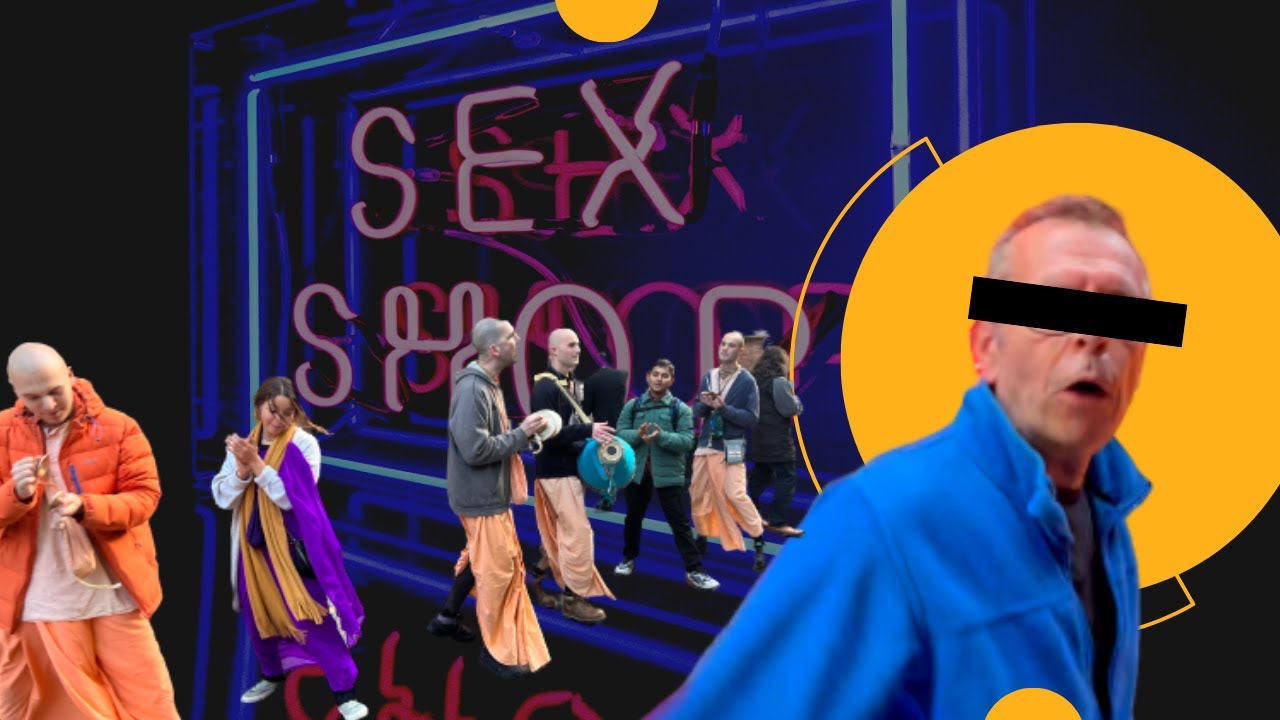
- Devotees Attacked by an Angry Sex Shop Owner
Please watch the video.
- Why The Existence Exists?
Srila Prabhupada answers this question in the most elaborate and sublime way in a conversation with philosophers. Guest (1) [German man]: I would like to ask you a question. Once Leibniz, who is one of the fathers of the Western tradition, formulated the question which was the beginning of metaphysics in a way, Western metaphysics. The question is, "Why there is anything?" What is your stand about this classic point? Prabhupada: Why...? Guest (1): Why there is anything? Prabhupada: Anything? Hrdayananda: Why anything exists? What is the reason for the existence of...? Professor: Existence of him. Prabhupada: [chuckles] "Why anything exists?" [laughter] What do you mean by "anything"? Guest (1): Well, that's precisely the point. What is the purpose? What is the sense, if there is any, or does the very question make sense? Prabhupada: No, no, unless understand what is that "anything..." First of all, you have to understand what is that "anything." Anything... Just like this book, this table, this bell, the electric, they are so many things. So you can take any one of them; that is anything. What is your idea of "anything"? Guest (1): Oh, reality. Material, external reality to our ego; our internal reality as well. Prabhupada: Internal reality and external reality? Guest (1): Both. For me, the word "anything" covers both. Prabhupada: Yes. So that also we understand, "anything." There are so many varieties of things, and you can take any one of them. That is "anything." But your question should be, "Wherefrom these things coming?" That should be the proper question. Professor: What is the reason of the existence of anything? Prabhupada: Yes. There are so many things, and you can take any one of them. That is "anything." But the real question should be, "Wherefrom all these things are coming?" That is real question, "What is the origin of all these things?" Guest (1): Well, origin, that is more on the theoretical side. It's a question... question, "Why?" But I am, rather, after the purpose. Prabhupada: Yes. That is a nice question. But there is the real source of everything. That is the Vedanta-sutra. Perhaps you have read. Vedanta-sutra, first question is, "Wherefrom all these things come?" So the answer is that janmady asya yatah [SB 1.1.1]: "Brahman. The original thing is Brahman, or the Absolute Truth, and from Him, everything is emanating." Just like physical... The sun is there, and whole material world is product of the sunshine. What your physical science says? [laughter] Eh? Eh? Do they not say? It is a fact that sunshine... Due to the sunshine all these material things are there. Guest (1): Well, it's more involved than just saying that. Sun is just a big complex of hydrogen and helium, a big pile of rubbish really, but it develops this marvelous reactions which causes it, work as a big nuclear reactor. That's an entirely different story, what the vision of science, of the present science, about the meaning of celestial bodies and the meaning of, in particular, of sun and moon and so on. We are extremely realistic about this world. We don't, we can't see, assuming all the glory of that what happens on the earth due to the existence of those bodies, we do not try to look inside of the structure of these things as something meant for us. Just universe as it is. And this question, like Nietzschean question which I am repeating -- that's not my point -- this big question is... Western philosophy presently does not answer, one does not ask this question. I think that this scientist who did ask it has quite a point. This question expresses this quest of the human race for some meaning, for some sense, for some sense. That's what religion is now offering us, or philosophies, or... Rarely, directly, we hear the direct answer to that. Prabhupada: What is your direct answer? Guest (1): Oh, I don't have any. If I would have, I wouldn't ask you. Prabhupada: That means your knowledge is insufficient. Guest (1): Precisely. Precisely. That is the beginning of [indistinct] wisdom We know we don't know. I am aware of that. Prabhupada: Therefore, if you have no answer... That's all right. That "We don't know" means our knowledge is insufficient. But knowledge means must be progressive. We should not remain in insufficient knowledge. We must make further progress to get sufficient knowledge. Inquiry. Guest (1): But you referred to some other, more direct ways of acquiring knowledge than just the standard study. Prabhupada: No, because we have got insufficient knowledge, we cannot approach directly. It is not possible. We have to take knowledge -- who has got sufficient knowledge, from him. Because you have got insufficient knowledge, so you cannot make progress. Just like beyond this wall, you cannot say what is there. That is insufficient knowledge. But that does not mean there is nothing. Because you cannot say what is beyond this wall, that does not mean that there is nothing beyond this wall. Your knowledge is insufficient. Is it not? Professor: Well yes but, this is, his was more or less like reaching a question I think... Prabhupada: Just try to hear. Then... Professor: If Indian philosophy proposes... Prabhupada: No, no, it is no "Indian" or "American." It is the philosophy. It is philosophy. The philosophy is not Indian or American. Truth is truth, not Indian truth or American truth. That is not truth. That is relative truth. The Absolute Truth is absolute. That is neither Indian nor American nor... Guest (1): But in what sense you use the concept "truth" here? Is it in the ontological sense, or is it in somehow in a more pragmatical, human sense, refers to human beings or...? Prabhupada: Yes, it is pragmatic, that you cannot see beyond this wall. That is your insufficient knowledge or your senses are insufficient. You cannot go beyond this wall. But that does not mean there is nothing beyond this wall. So if you want to know what is beyond this wall, you have to know from a person who knows it. Professor: Yes, that is correct. Yes. Prabhupada: Yes. Because you cannot see, you cannot know, that is not the end. There must be something. Guest (1): Why? Prabhupada: Eh? It is actual fact. That is pragmatic. It is actual fact. There is... So many things there are, but you do not know because your senses are imperfect. Your eyes are imperfect, your touch, imperfect, the gathering senses... The senses which gathers knowledge... Just like eyes... We can see and gather knowledge. We can hear; we gather knowledge. We can taste; we gather knowledge. So, because your senses are imperfect, therefore your knowledge gathered, that is imperfect. Professor: But for instance in the case of a mystical man that has been able to see... [indistinct]... man has been able to see... [indistinct].... yes. Prabhupada: There is no question of mystic. First of all we have to admit that on account of our senses being imperfect, whatever knowledge we gather, that is imperfect. That is imperfect. Therefore, if you want to possess real knowledge you have to approach somebody who is perfect. Professor: Yes, yes. Prabhupada: You cannot... Huh? Guest (1): How can we know that somebody is perfect? Prabhupada: That is another thing. But first of all, the basic principle is we have to understand that our senses are imperfect, and whatever knowledge we gather by this imperfect senses, there imperfect. So if we want perfect knowledge, then we have to approach somebody who is, whose senses are perfect, whose knowledge is perfect. That is the principle. That is the Vedic principle. Therefore the Vedic principle says, tad-vijnanartham sa gurum evabhigacchet, tad-vijnanartham sa gurum evabhigacchet samit-panih srotriyam brahma-nistham "To understand these things properly, one must humbly approach, with firewood in hand, a spiritual master who is learned in the Vedas and firmly devoted to the Absolute Truth." [Mundaka Upanisad 1.2.12] You know Sanskrit, yes? "In order to know that perfect knowledge, one should approach guru." So who is guru? Then the next question will be. Your question is that, "How I can?" Guest (1): How can I know that...? Prabhupada: That I am coming. That I am coming. Guru... That is next line. It is said, srotriyam brahma-nistham. Guru means who has properly heard the Vedas, sruti. Srotriyam. And as a result of his hearing he is firmly convinced in the existence of the Absolute Truth, God. Professor: Well, this is... We've only come to one of the, as I mentioned, the theories of knowledge, I think, sabda. Prabhupada: Sata? Professor: Sabda. Prabhupada: Sabda, yes, sabda-brahman. Yes. Professor: Then if you are able to communicate to have this knowledge through sabda, what? Prabhupada: Yes. Sabda-brahman. Just like many thousands of miles away we are getting some radio message and we learn that "Something is happening there. Something is there." Therefore sabda. This is... Sabda means sound. Sound. Sound vibration. So that is the real source of knowledge. That is the real source of... Sabda-brahman. Professor: One of the sources of knowledge, of the only one? Prabhupada: No, that is the only one. There are others; they are subordinate. But the sabda, knowledge received, sabda, through sabda, sabda-brahman, that is perfect knowledge. Just like the same example: beyond this wall I cannot see, but if somebody there says, "This is the position here" -- the sound comes -- that is perfect. You cannot see what is going on, but if somebody says..., sends radio message or any message, sound, then you know. Therefore sabda-pramana, sabda, knowledge received through sabda, that is perfect knowledge. Professor: That means that through sabda, and through other means you can have a direct intuition, but you can't intact... Direct intuition of things. Prabhupada: Intuition is different. Direct perception. Sabda, you can direct perception. It is not intuition; it is perception. Therefore the word is used, srotriyam brahma-nistham [Mundaka Upanisad 1.2.12]. [To understand these things properly, one must humbly approach, with firewood in hand, a spiritual master who is learned in the Vedas and firmly devoted to the Absolute Truth.] So our process is to receive knowledge through sabda-brahman, Vedic. Just like eko narayana asit. Eko narayana asit: "Before creation there was only Narayana." Na brahma na isah: "There was no Brahma; there was no Siva." So this is sabda-pramana, sabda-pramana, that "In the beginning there was God; nothing else." So in this way our Vedic principle is: when your knowledge is corroborated by the Vedic version, then it is perfect. Professor: But according to Sankara, if I am interpreting well, it is not only way that you can approach truth. You can also approach through deduction. Prabhupada: There are many ways. Just like hypothesis. Hypothesis. Yes. History, history. Hypothesis, history. Then direct perception. There are many. But the, of all these, sabda-pramana is taken as best. Sabda-pramana, evidence through the sound. That is the best. Professor: Yes, but... I'm coming again to [indistinct]. According to, if I am correct, I want to know what the use is, if one prove, can prove the value, existential value of a thing, through deduction... If it is possible or not only through intuition, through direct intuition of the reality of the thing? Prabhupada: Value by intuition? Professor: Knowledge of the existence of a thing, of anything. Prabhupada: Yes. The knowledge of existence, that nityah-sasvato 'yam [Bg 2.20], nityah sasvatah, that is knowledge of existence. [For the soul there is never birth nor death. Nor, having once been, does he ever cease to be. He is unborn, eternal, ever-existing, undying and primeval. He is not slain when the body is slain.] So you have to learn which is nitya and which is not nitya from the authority. "This is nitya, and this is anitya." So nityo nityanam cetanas cetananam [Katha Upanisad 2.2.13]. [The Supreme Lord is eternal and the living beings are eternal. The Supreme Lord is cognizant and the living beings are cognizant. The difference is that the Supreme Lord is supplying all the necessities of life for the many other living entities.] These are the Vedic versions: "There is one chief nitya amongst the many nityas." Just like we, we living entities, we are nityas, eternal. First of all try to understand eternity. You were a child or I was a child. Now that body, child body, is no longer existing. But I understand, I know, that I had a body, child. That I am nitya. I am existing. The body has gone, but I am existing. Therefore I am eternal, nitya. Is it clear? Professor: Well, I remember one other explanation, that when you are sleeping and you have a dream... Prabhupada: No, when I am sleeping I am working. Professor: ...and you have a dream, and then, when you are coming back from sleep... Prabhupada: Yes. Professor: ...you can remember your dream. Prabhupada: Yes. Professor: That means that you are conscious of your existence even on the suppression of consciousness. [laughs] Normal... [indistinct]. Prabhupada: I am not only conscious, but the consciousness depends on me. Because I am there, therefore consciousness. So I am nitya. This is the proof of nitya, that many changes have taken place, but the changes, the phenomenal changes, they have gone out. They are no more existing. Therefore they are not nitya. Just like dream. At night I saw one dream, but the dream is no more existing, but I remember that last night I saw the dream. Therefore I am nitya and the dream is anitya. The dream is anitya. Similarly, this phenomenal world, when I am not sleeping, but I am so-called awakened, so I am seeing. I am seeing you, I am seeing this table, this book, you see, but... [aside:] Don't... But when I am asleep I forget all these things. I forget. I am in a different world. I am seeing different things. So this is also dream, and the dream at night, that is also dream. But I, the seer of this dream and that dream, I am the eternal. Professor: But this is not to make depending on the conscious of any individual the existence of things. Prabhupada: Existence of thing... I say that at night, when I am dreaming, I do not see existence of these things. And at this time, in daytime, when I am seeing these things, I do not see the existence of the dream. So the conclusion should be both these things I see in daytime and I see at night, they have no existence. They are phenomenal. But I am the seer; I am eternal. I am existing. This is the proof. Because at night I am seeing and daytime I am seeing, so therefore I am eternal. But the phenomenal manifestation, they are temporary. We don't say it is false. Temporary. The Mayavadi philo... Sankara said it is false. Brahma satyam jagan mithya. Mithya means false. We don't say false. We don't say that this book is false. It has got reality, but temporary. This book has come into form at a certain date, and it will exist for certain days, and when it will be worn out or old, there will be no existence. Therefore the formation of this book is temporary. But I am the reader of the book; I am eternal. So two things are there: temporary and eternal. The temporary existence, somebody says "False," but we say, "It is not false; it is temporary." But there is an eternal existence. Just like I am eternal. That is... We have to learn from sabda, vibration. Na hanyate hanyamane sarire [Bg 2.20]. You understand Sanskrit. Na hanyate hanyamane sarire. That eternal thing is exist, existing, it will continue to exist. Even after the destruction of this temporary body, it will continue to exist. Professor: But coming again to the question that Dr. [indistinct] put to you, but it is possible to understand all those things [indistinct] and hear in the sense of [indistinct]? Prabhupada: You have to understand... I have already said that we have got our imperfect senses. We cannot understand. But we have to understand from a person who has got perfect knowledge. Professor: But why the existence of all these things, why the existence of all these things [indistinct]... knowledge. Prabhupada: So? Why? Then the answer will be: "Why there shall not be existence?" First of all you answer this. If you question like that -- "Why there is existence?" -- then I shall inquire, "Why there shall not be existence?" Therefore the decision should be taken from the Absolute. Your question, my answer, will not solve. If you say, "Why there is existence?" I can ask you, "Why there shall not be existence?" And who will decide this? Guest (1): If I may say something, this basic question, I suppose, may be asked only on the level of all religion, all philosophy, which does not put a line of division between practice in life... Prabhupada: Yes. Guest (1): ...and abstract investigations. Now, in normal Western thinking we do deny the very purpose of that question. As a matter of fact, we never ask it. Since time was when Leibniz did ask this question we all forgot it, or deliberately we suppress it. We simply say, "All right, let's be concerned only with those things which we can deal with effectively in material world. And the question of purpose, let's leave aside." Now, I suppose that within this system of thought which you have... Prabhupada: I may tell you two things. The purpose is... That is experienced by every one of us, what is the purpose of life, what is the purpose anything. That, everyone, we can understand very easily. The purpose is ananda, pleasure. Professor: [indistinct]. Prabhupada: That is the purpose. There is no difficulty to understand what is the purpose. The purpose is pleasure-seeking. Or purpose is pleasure. One who hasn't got the pleasure, he's seeking after it. That is the purpose. Purpose is ananda. Anandamayo 'bhyasat [Vedanta-sutra 1.1.12]. [By nature, the Supreme Lord is blissful.] That is the Vedanta-sutra. Every one of us, seeking ananda. The scientific knowledge, philosophy, or even driving the car or whatever you are doing -- the purpose is ananda. That is a common factor. Purpose is... Why I am eating palatable dishes? I can eat anything, but I am seeking that "This sort of foodstuff will please me." That is ananda. Guest (1): That is driving force and motivation of most of human activities. But the question, purpose, which Leibniz was asking for, he was asking on higher plane, in abstraction. Prabhupada: Higher plane means you are seeking after pleasure, but that is being obstructed. That is your position. You are seeking pleasure, but it is not unobstructed. Therefore you are seeking higher, where there is no obstruction. Pleasure is the purpose, but when you speak of higher plane, that means you are experiencing obstruction in getting pleasure. So you are seeking a platform where there is no obstruction. But the purpose is the same. Guest (1): Must it necessarily be so? That would be so, supposing that we human beings are precisly the center of existence, and all criteria should be applied, measuring everything what exists. Now, the question, "Why there is anything?" is asked on the more higher, I said higher, level, in the sense, trying to forget about this anthropocentric thinking. This why... Prabhupada: No, thinking... Guest (1): Why everything relates to everything what may exist -- other beings, other intelligences. That is... [indistinct] Prabhupada: This is a fact, that intelligent or not intelligent, that doesn't matter. Everyone is seeking pleasure, ananda. The Sanskrit word is ananda. So ananda... Suppose I am constructing big a house to live there, but before the construction is finished I am, by nature, I am taken away, I die. Just like Napoleon. That, in France, that Arc in Paris? Devotee: Arc de Triomphe. Prabhupada: He could not finish it. You see? There are so many things. We are thinking, "By finishing this, we shall be happy," but that is sometimes hampered. So ananda is checked. So this is the position. So higher means where ananda is not checked. That is higher position. The purpose is ananda, but in this material world we are experiencing ananda being checked. Just like nobody wants to die. That's a fact. Why he shall die? I already discussed that I know that I was a child, I was a boy, I was a young man, and now I have got this body, old man's body. It is now going to finish. So I am little anxious. Now, whatever ananda I was drawing in my living condition, now it is going to be finished. But if we think properly, that "I am eternal, so although the body will be finished, I'll not be finished..." This is very natural, which, "I was not finished. Because my childhood body was finished, so I was not finished. My boyhood body was not finished; I was not finished. My youthhood was finished, but I was not finished." Similarly, the conclusion should be: "Even though this body will be finished, I'll not be finished." That is stated in the Bhagavad-gita: tatha dehantara praptir dhiras tatra na muhyati [Bg 2.13]. [As the embodied soul continually passes, in this body, from boyhood to youth to old age, the soul similarly passes into another body at death. The self-realized soul is not bewildered by such a change.] Dhira, one who is intelligent, he is not disturbed. Dhiras tatra na muhyati. So dhira, one who is dhira, sober, philosopher, he knows that "I am not going to be finished. I shall have to accept another body." Now, whether that body will be ananda? That is the consideration. I'll get another body, just like I have got this body, after changing so many bodies. Moment after moment, we are changing body. That is the medical science, changing of blood corpuscles. So this body will be changed again. Then I will have to enter the mother's womb and packed up for at least ten months in suffocated condition. This is scientific, all. Then again I'll come out when the body is prepared nicely to come out and exist. So that period of formation of body is not ananda. To remain compact in this way for ten months, it is not ananda. It is not ananda; just opposite ananda. Then when we die... Die, death means the miserable condition is so great that we cannot live. We have to go out. So there is no ananda. Then, when we have got this body, changing, there is no ananda because we are sometimes diseased, and to become old man, that is also not ananda. Therefore I am eternal; I'm seeking after something which is eternal ananda. Therefore next considerance should be that "Whether this condition of repetition of birth, death, old age and disease can be changed?" That is next question. And if there is possibility, then we shall try for that. But there is possibility here. The conclusion is: so long we get this material body... Because matter is not eternal. Anything you take, material -- earth, water, fire, air, sky, mind, intelligence and false ego, these are all material things. So these material things, they are not eternal, none of them. This table is created; it is not eternal. It will be finished at a certain date, anything you take. But I am eternal. So if I transfer myself in another nature which is eternal, then my ananda will be eternal. That is the purpose of life. Professor: Not that the, [indistinct] identity between atman and..., in the sense of the atman... Prabhupada: Yes, I am atma. You are atma. Atma. Professor: ...the atman of the world, let's say, the absolute atma. Prabhupada: Yes. The atma and Paramatma, Paramatma. As I was speaking, nityo nityanam. We are all nityas, eternal, but there is one chief nitya. Just like leader. Anywhere we go, we have got a leader. Now this, your Mexico state, there is a president. You cannot avoid it. In your college there is principal. There must be a leader. Similarly, the whole thing taken together, there must be one leader. You have to speak from experience that in your physical department or in your religious department there is a chief, leader, professor. Or you may be. But that is the way. Therefore Vedic information is that we are eternals, but there is another eternal who is chief eternal. That is God. He is eternal; we are also eternal. Then what is difference? The difference is that eko yo bahunam vidadhati kaman: "That one eternal, chief eternal, He is maintaining all the subordinate eternals." So both the eternals are eternal and... The purpose is pleasure. Just like a small example: a family man. The father is the chief man in the family. The mother is there, the children are there, all together. But the father is the chief man in the family. He is maintaining the family, and there is ananda, pleasure. Similarly, ananda is the aim of both..., all the eternals, the chief eternal or the subordinate eternal. But the supplier is the chief eternal. So when we come together, the chief eternal and the subordinate eternals, and enjoy together, that is the purpose of life. [pause] Professor: According to existential philosophy... Indian philosophy I am thinking about, like for instance the Ramakrishna and Vivekananda and all these... Prabhupada: They are not philosopher. Professor: They are all [indistinct] variations. Prabhupada: They have no philosophy. Professor: Eh? Prabhupada: They have no philosophy. Professor: I said you are also proposing the possibility to acquire knowledge through contact. Prabhupada: Our position is -- I have already explained -- that we are all imperfect. Therefore we have to take knowledge from the perfect. So God is perfect, or Krsna is perfect, so we have to receive knowledge from Him. Then our knowledge is perfect. And so long we shall speculate, that is not perfect. Because you are speculating with imperfect instruments, what is the use? Professor: [indistinct]... Thing that the only way to aquire... through sabda. Prabhupada: If I want to cut this table, I must have proper instrument. If I want to cut this table with this book, "Let me cut this," how it will be possible? You must know that for cutting this table it requires this instrument. Professor: Yes, they say that the only way to acquire knowledge is through sabda. Prabhupada: Yes. Sabda-pramana. Professor: And I think other pramanas will be also possible according to those. Prabhupada: Just like I am trying something, and some experienced man says, "Do like this." This is sabda-pramana. The sabda-pramana, one who is..., knows, he says, "Do like this." The "Do like this" means sabda, sound, and it enters your ear, and you do adjustment. Therefore sabda-pramana. Just like you are sleeping, and one is..., another man is coming to kill you. And another friend says, "Get up, get up, get up! There is enemy. He is coming to kill you." Then you wake up. Therefore the sound is the pramana there was enemy. These are crude examples. When you are asleep, you cannot understand. You have got eyes, you have got hands, you have legs but no experience, but the ear gives you warning even if you are sleeping. There is enemy -- your eyes cannot see, your hand cannot touch, but the ear can give you evidence, "Yes." As soon as you are awakened you say, "Yes, here is enemy. He is coming to kill me." Therefore the aural reception, sound reception, is the evidence. Knowledge received through authentic sound vibration, that is perfect. Room Conversation with Woman Sanskrit Professor – February 13, 1975, Mexico City
- When A Wife Becomes A Guru to Her Husband
In the Vedic civilisation it was the custom that the husband became a natural guru to his wife. However, Srila Prabhupada also speaks of times, when it can be the other way around. SP Letter to: Silavati, New Vrindaban, 14 June, 1969 "My Dear Silavati, Please accept my blessings. I thank you very much for your letter dated June, 1969, and I have carefully noted the contents therein. Regarding the suggestion that you remarry, I have never suggested such thing, so you need not trouble yourself with this. As I have told you in Los Angeles, I wish that the mother's who have no husband at present should not remarry, but should dedicate their time to seeing that their children are brought up very nicely in Krishna Consciousness. Your boy, Birbhadra, has just arrived here, and he will be taken care of by Kirtanananda Maharaja. Satyabhama Dasi is in charge of educating the children in New Vrindaban, and she is very qualified to do this because she is educated and works very nicely with the children. So there is no difficulty at present in this regards, and as you are so nicely engaged in your activities in Los Angeles, you should continue as you are now doing. Your description of the course you are giving to the interested girls about the role they play in Krishna Consciousness is very nice, and I am pleased that you have begun this project. Actually the role of all conditioned souls is the same; to chant Hare Krishna, tell others to chant, perfect our lives in Krishna Consciousness, and to go back to Godhead when this body is finished. Now if you can induce all the women of Los Angeles to place an altar in their homes and help their husbands have peaceful, happy home life in Krishna Consciousness, that will be very great service for you. The actual system is that the husband is Spiritual Master to his wife, but if the wife can bring her husband into practicing this process, then it is all right that the husband accepts wife as Spiritual Master. Caitanya Mahaprabhu has said that anyone who knows the science of Krishna, that person should be accepted as Spiritual Master, regardless of any material so-called qualifications; such as rich or poor, man or woman, or brahmana or sudra. So if you can show the women of the community how to help their husbands and children to perfect their home life, and all aspects of life, in Krishna Consciousness by chanting, aratrik ceremonies, and eating Krishna prasadam, then you will improve the conditions of the neighboring communities to an incalculable extent. So try for this as far as possible. I already have practical experience that many of the American girls and boys are very intelligent and qualified to take up this sublime movement. We simply have to instruct them nicely, and surely many will understand that here is such a nice thing and they must take to it. So I am very pleased with the nice efforts you are making. I hope this will meet you in good health. Your ever well wisher, A.C. Bhaktivedanta Swami"